How To Avoid Deck Railing Contractor Scams With Practical Vetting Methods
Residential building safety depends heavily on guardrail integrity. Property owners often view deck railing replacement as a simple cosmetic upgrade. However, structural engineers recognize guardrails as life-safety systems designed to resist high lateral impact forces. When unvetted operators execute these installations, the financial and physical consequences become severe.
Unscrupulous operators exploit the gap between consumer perception and trade reality. These entities leverage polished online storefronts, persuasive sales tactics, and deceptive pricing models. Homeowners routinely mistake marketing polish for operational legitimacy. Consequently, predatory contractors secure large cash deposits before property owners identify underlying regulatory or structural deficiencies.
Protecting real estate assets requires systematically analyzing contractor operational models. Vetting protocols must extend beyond casual review aggregation and superficial reference checks. Understanding the legal, financial, and structural dynamics of specialty contracting allows property owners to preserve capital while ensuring structural code compliance.
Understanding “How to Avoid Deck Railing Contractor Scams”
Learning how to avoid deck railing contractor scams requires recognizing that deceptive practices operate along a wide spectrum. Fraud rarely manifests as an immediate, obvious disappearance with deposit money. More frequently, scams manifest through subtle scope reduction, substandard material substitution, and intentional non-compliance with local building codes.
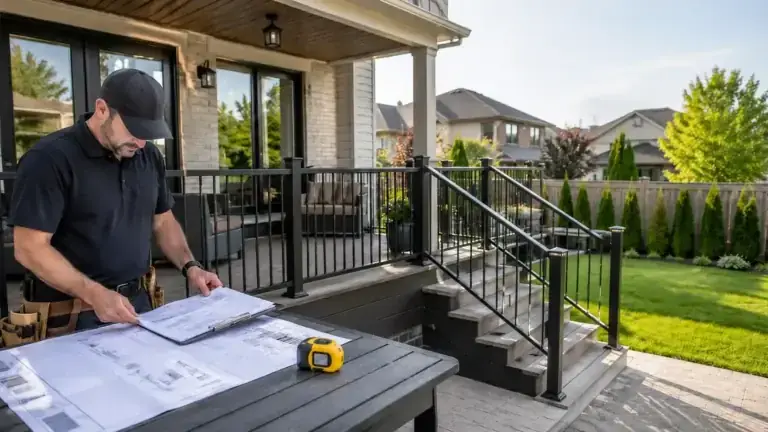
Property owners must establish a systematic vetting sequence before engaging any home improvement worker. First, initial inquiries should always be followed by independent state license and insurance verification. If credentials are found to be invalid, the bid must be rejected immediately. When credentials pass inspection, the owner should insist on a fully itemized written scope and specified material grades. Next, a milestone-based payment structure must be established using an escrow arrangement. Finally, municipal permits must be pulled and city inspections completed before final lien waivers are collected.
The Misunderstanding of Surface Legitimacy
Homeowners often assume that a professional website, branded vehicles, and quick communication signal business stability. Fraudulent operators intentionally invest in high-converting sales funnels because initial consumer trust yields high immediate returns. Operational legitimacy is only proven through active trade licenses, verified general liability policies, and worker’s compensation certificates issued directly from insurance underwriters.
The Oversimplification of Code Compliance
A common mistake involves treating building permits as optional administrative hurdles. Contractors who urge property owners to bypass permitting often claim to save the owner time and municipal fees. In practice, bypassing municipal oversight hides inadequate post blocking, improper fastener selection, and structural frame deficiencies from professional building inspectors.
Deep Contextual Background
Contractor fraud in residential construction evolved alongside shifts in digital lead generation and building material manufacturing. Historically, home improvement schemes relied on door-to-door solicitation and localized cash transactions. Community word-of-mouth networks created natural geographic boundaries that limited fraudulent operations.
Digital Disintermediation and Lead Platforms
The proliferation of digital lead aggregation platforms disrupted traditional vetting mechanisms. Contractors buy consumer leads in bulk, utilizing automated sales scripts to secure signatures before homeowners conduct due diligence. Search engine optimization tactics allow newly formed entities to simulate decades of regional presence, effectively decoupling public visibility from proven operational capability.
Material Complexity and Knowledge Asymmetry
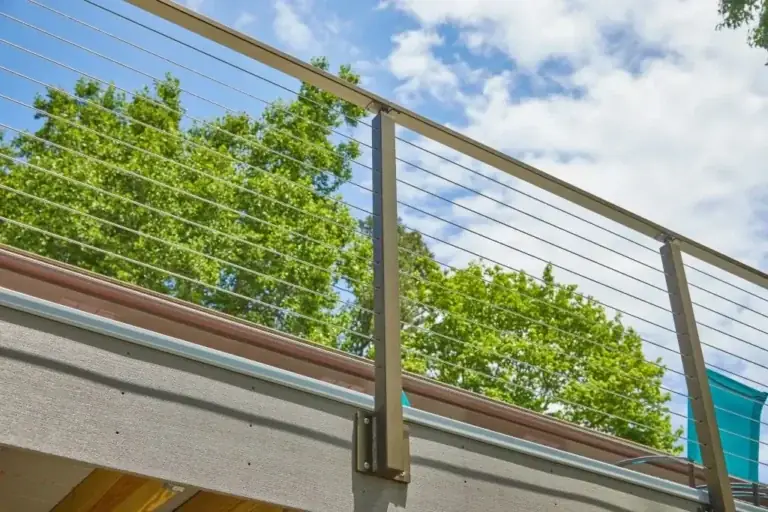
Modern railing designs have evolved from simple wood balusters to engineered cable, glass, and composite systems. These materials require precise load-path engineering, specialized tensioning tools, and specific anti-corrosion hardware. Dishonest operators take advantage of this technical complexity by charging premium rates for advanced systems while secretly installing sub-grade components that fail prematurely.
Conceptual Frameworks and Mental Models
To evaluate contractor credibility effectively, property owners should apply structured decision-making models rather than relying on intuitive trust.
The Capital Exposure Framework
This model evaluates the financial exposure at every phase of the project construction timeline. By calculating the ratio of cumulative payments to physical materials delivered on-site, owners ensure that leverage remains with the client. Paying excessive upfront deposits shifts capital control entirely to the contractor, creating asymmetric operational risk.
The Regulatory Friction Principle
Legitimate trade contractors operate within established regulatory boundaries without resistance. They view municipal permitting, structural inspections, and licensing board oversight as standard operating procedures. When a contractor expresses strong resistance to regulatory friction, it signals operational instability or an inability to pass official code inspections.
Information Asymmetry Reduction
Contractors naturally possess superior technical knowledge regarding structural code requirements and wholesale material costs. To counter this imbalance, homeowners must independently research local structural guardrail codes, including minimum concentrated load requirements and maximum baluster spacing rules, before engaging in contract negotiations.
Key Categories or Variations
Understanding the operational models of deceptive contractors enables property owners to identify red flags during initial consultation stages.
The High Upfront Deposit Model
Contractors demand half or more of the total contract price upfront under the guise of custom ordering specialized materials. Once funds transfer, the contractor postpones installation indefinitely or disappears completely.
The Unpermitted Fast-Track Scheme
The contractor promises a rapid installation timeline by skipping city building permits. This practice hides underlying structural deficiencies, such as missing joist blocking or incorrect fastener shear strength, which exposes the owner to severe safety liabilities.
The Sub-Grade Material Substitution
The contract specifies marine-grade 316 stainless steel cable or high-density aluminum posts. However, the contractor installs lower-cost 304 stainless steel or low-grade painted iron that rapidly oxidizes when exposed to exterior weather conditions.
The Subcontractor Lien Trap
The general contractor collects complete payment from the homeowner but neglects to pay material suppliers or hired specialized installers. Subcontractors subsequently place mechanics’ liens against the property title to recover their unpaid balances.
The Mid-Project Scope Expansion
The contractor begins demolition, removing the existing guardrail, and then halts work. They claim unexpected structural decay requires exorbitant, unitemized price increases before installation can resume.
Operational Fraud Category Comparison
| Fraud Category | Financial Risk Level | Structural Hazard | Detection Vector | Primary Protection Mechanism |
| High Deposit Scheme | Critical | None (No Work) | Demand for >30% upfront | Milestone-based payment schedules |
| Permit Evasion | High | Severe | Excuses regarding city delays | Independent permit verification |
| Material Substitution | Medium | Moderate | Lack of manufacturer labeling | Site delivery hardware inspection |
| Subcontractor Lien | Severe | Low | Direct calls from suppliers | Unconditional lien waiver collection |
| Unjustified Scope Changes | Medium | Moderate | Mid-project work stoppage | Fixed-price detailed scope clauses |
Detailed Real-World Scenarios How to avoid deck railing contractor scams
Scenario A: The Omitted Structural Blocking
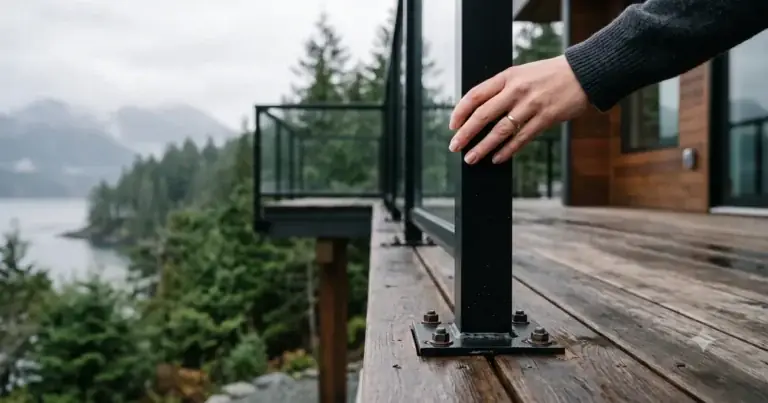
A homeowner hires a contractor to install a top-tier glass railing system on an elevated composite deck. The contractor mounts post brackets directly to the surface decking without installing internal structural joist blocking underneath. In a substandard installation, lag screws penetrate only the decking board, leaving an empty air space beneath that inevitably leads to anchor pull-out. In contrast, a code-compliant mounting requires thru-bolts that pass through the deck board, a solid doubled framing block, and are secured with steel washers and nuts underneath. During a high-wind storm, improper surface anchors pull free, causing total structural failure.
The second-order consequence extends beyond immediate repair costs. The property owner’s insurance carrier denies the claim, citing unpermitted craftsmanship and improper structural installation. The owner must pay out-of-pocket for full deck frame reconstruction.
Scenario B: Uninsured Subcontractor Injury
An independent laborer working for an unvetted general contractor falls from a second-story deck ledger while tensioning cable lines. The general contractor provided a fraudulent certificate of insurance at contract signing. The injured worker sues the property owner directly for medical expenses and lost wages, securing a lien against the home equity.
Planning, Cost, and Resource Dynamics
Accurate cost estimation protects property owners from falling for artificially low bids that contractors use to secure contracts before adding unexpected change orders.
Realistic Railing Installation Pricing Structures
| Material System | Average Cost Per Linear Foot | Typical Deposit Range | Critical Inspection Point |
| Pressure-Treated Wood | $40 – $75 | 10% – 15% | Post-to-frame bolt connection |
| Powder-Coated Aluminum | $80 – $150 | 10% – 20% | Base plate anchor torque |
| 316 Stainless Steel Cable | $110 – $240 | 15% – 25% | Intermediate post deflection |
| Architectural Tempered Glass | $160 – $380 | 20% – 30% | Channel shoe structural mount |
Tools, Strategies, and Support Systems
Deploying systematic verification workflows helps property owners maintain project control and protect capital reserves.
License and Insurance Verification
Always request insurance certificates sent directly from the underwriting agency rather than accepting photocopies from the contractor. Verify active licensure through state contractor licensing board databases, checking for recorded complaints or administrative actions.
Escrow and Payment Milestones
Utilize bank escrow services or structured payment schedules tied directly to verifiable construction milestones. Never release progress payments until specific installation stages pass required municipal inspections.
Material Tracking and Site Audits
Inspect material deliveries before installation begins. Verify that cable components display 316-grade stamps and that glass panels carry regulatory safety temper marks.
Risk Landscape and Failure Modes How To Avoid Deck Railing Contractor Scams
The failure modes associated with improper railing installations extend across legal, financial, and physical domains.
The compounding risk cascade usually starts when an unlicensed contractor is hired to cut costs. Next, municipal permits are routinely bypassed to avoid regulatory oversight. Because no inspector is present, substandard post mounts are installed directly to the deck boards. Eventually, a structural guardrail failure occurs under normal load, which ultimately leads to a denied insurance claim and a title lien placed against the property.
Legal and Title Clouding Risks
Failure to secure lien waivers creates title liabilities that hinder future real estate sales. Unpaid supplier bills remain attached to the property regardless of contract language between the owner and the general contractor.
Physical Safety Hazards
Guardrail systems must withstand a minimum concentrated lateral force of 200 pounds applied at the top rail. Improper mounting hardware or missing structural blocking causes total connection failure under standard usage conditions.
Governance, Maintenance, and Long-Term Adaptation
Long-term structural reliability requires active project monitoring and structured review cycles during construction.
Pre-Contract Execution Checklist
-
Verify active contractor state licenses and specialty trade certifications.
-
Obtain certificate of liability insurance directly from the insurance carrier.
-
Confirm that local municipal building permits are applied for and posted on-site.
-
Insert detailed material specifications into the written contract scope.
-
Establish a milestone payment schedule tied to passed city inspections.
-
Require signed unconditional lien releases for all progress payments.
Measurement, Tracking, and Evaluation
Evaluating project success requires measuring both leading indicators during construction and lagging performance metrics over time.
Real-time project control relies heavily on leading indicators. These include verifying permit approval before demolition, performing on-site hardware grade inspections, and confirming that the rough frame structural inspection has been officially passed.
Conversely, lagging indicators measure long-term performance after the job is completed. Key lagging signals include observing zero post deflection under active lateral load, verifying the total absence of corrosion around fastener joints, and maintaining a clear real estate title free of mechanics’ liens.
Common Misconceptions and Oversimplifications
-
Myth: Online review stars guarantee high operational standards.
Fact: Review profiles can be inflated through paid services or manipulated by removing negative feedback through legal threats.
-
Myth: Homeowner insurance policies automatically cover bad contractor craftsmanship.
Fact: Standard home policies explicitly exclude coverage for poor workmanship or non-compliant installations.
-
Myth: Written estimates serve as legally binding contracts.
Fact: Estimates are preliminary price projections. Only fully executed contracts with explicit terms protect property owners.
-
Myth: Building permits are merely a tax collection mechanism.
Fact: Permits mandate independent code inspections that verify structural safety and correct hardware attachment.
Ethical, Practical, or Contextual Considerations
Maintaining realistic budget expectations is essential when planning exterior renovations. Pushing contractors for below-market pricing often forces legitimate businesses to decline work, leaving homeowners exposed to predatory operators who intend to cut corners on material quality or structural safety. Fair compensation supports skilled trade labor and compliant installation methods.
Conclusion
Protecting property assets requires structured vetting, clear legal agreements, and rigorous payment controls. By decoupling sales presentations from operational capability, property owners can evaluate contractors objectively. Independent license verification, permit enforcement, and milestone-based payment schedules eliminate the primary vectors that fraudulent operators exploit.
Understanding how to avoid deck railing contractor scams empowers property owners to oversee exterior projects with confidence. Prioritizing structural compliance and clear contractual safeguards ensures that final installations provide long-term safety, preserve capital, and protect real estate value.